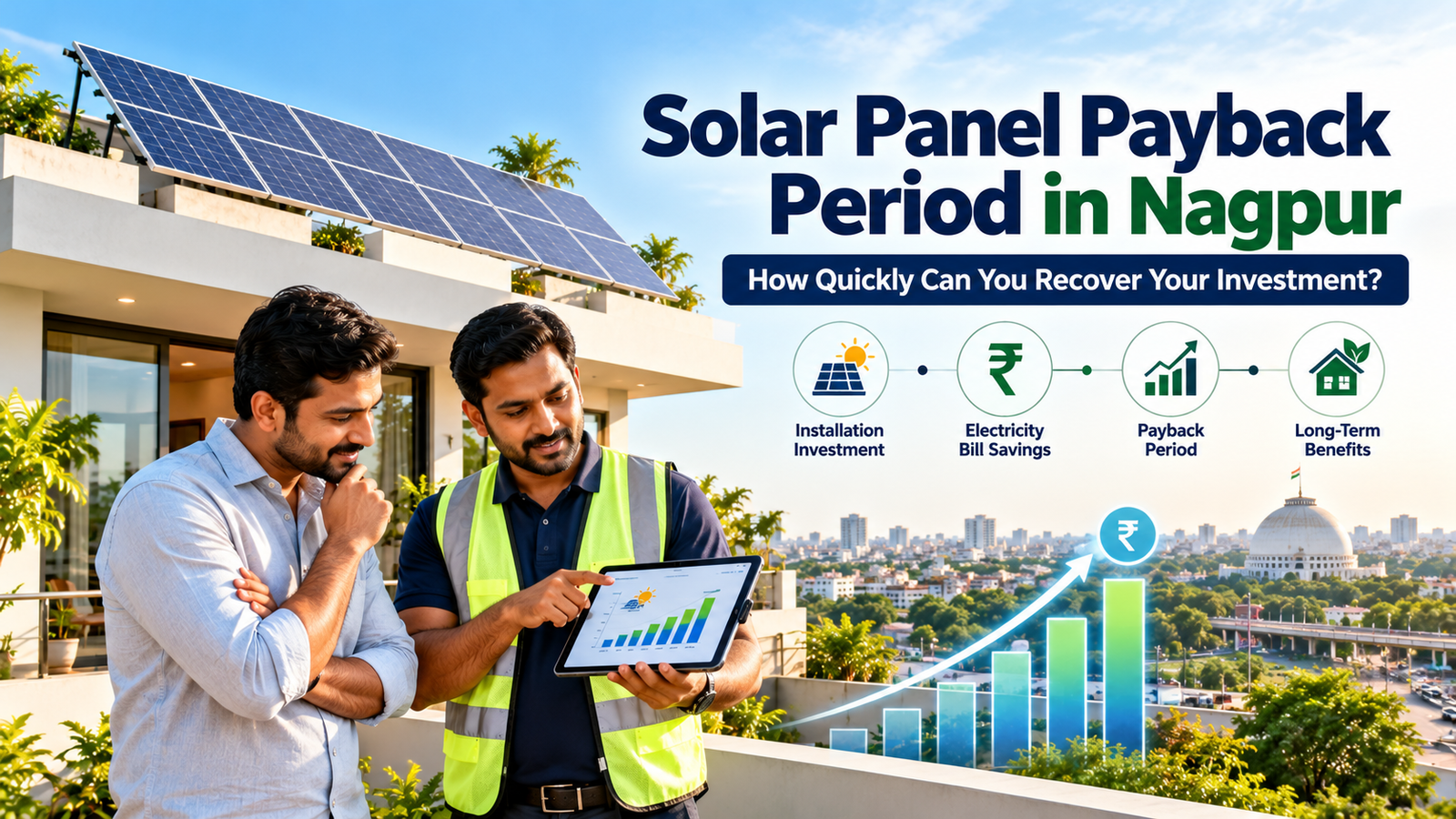
Solar Panel Payback Period in Nagpur: How Quickly Can You Recover Your Investment?
With rising electricity expenses and growing interest in renewable energy, many homeowners and businesses in Nagpur are considering rooftop solar installations. Solar panels allow properties to generate electricity from sunlight, potentially reducing dependence on grid power and lowering monthly electricity bills.
However, before investing in a solar system, one important question needs to be answered: How long does it take to recover the cost of solar panel installation in Nagpur?
The solar panel payback period refers to the time required for the financial savings generated by a solar system to equal its initial investment. For properties in Nagpur, the recovery period depends on installation costs, electricity consumption, solar generation, applicable subsidies, and local electricity billing regulations.
In this guide, we explain how to calculate the solar panel payback period in Nagpur, which factors influence it, and how homeowners and businesses can make informed solar investment decisions.
What Is the Solar Panel Payback Period?
The solar panel payback period is the estimated time needed to recover the initial cost of purchasing and installing a solar energy system through accumulated financial savings.
For example, suppose a homeowner invests ₹2,00,000 in a rooftop solar system and achieves annual net savings of ₹40,000. Under these assumptions, the initial investment would be recovered in approximately five years.
This is a simplified example, not a guaranteed result for every household in Nagpur. Actual savings depend on the amount of electricity generated, how much solar power is consumed directly, electricity tariffs, maintenance expenses, and other factors.
After the payback period, the system may continue generating electricity and delivering financial benefits throughout its remaining useful life.
However, solar energy does not necessarily eliminate every electricity expense. Fixed charges, grid electricity consumption, maintenance, and future equipment replacements may still contribute to household costs.
Why Is Solar Energy Worth Considering in Nagpur?
Nagpur enjoys plenty of sunshine throughout much of the year, making rooftop solar a practical option to consider for suitable homes and commercial properties.
The amount of electricity generated by a solar system depends on several conditions, including panel orientation, shading, roof space, seasonal weather, and equipment performance.
Solar energy may offer the following advantages to Nagpur property owners:
- Potential electricity bill savings: Generate part of your property’s electricity instead of purchasing all of it from the grid.
- Better control over energy expenses: Reduce exposure to some future changes in electricity prices.
- Efficient rooftop utilisation: Use suitable roof space to generate renewable electricity.
- Long-term financial benefits: Continue generating power after the initial investment has been recovered.
- Environmental benefits: Reduce reliance on conventional grid electricity when solar generation replaces it.
The financial value of these benefits depends on the property’s electricity requirements and the design of the solar installation.
How to Calculate the Solar Panel Payback Period in Nagpur
Calculating the payback period helps you understand how your solar investment may perform financially.
The basic formula is:
Solar Payback Period = Net Initial Investment ÷ Annual Net Savings
Where:
- Net initial investment is the total installation cost minus any eligible subsidy actually received.
- Annual net savings is the estimated yearly reduction in electricity expenses after accounting for relevant operating and maintenance costs.
Example of Solar Payback Calculation in Nagpur
Consider a hypothetical residential solar installation with the following figures.
| Cost or saving | Illustrative amount |
| Total solar installation cost | ₹2,00,000 |
| Eligible subsidy received | ₹30,000 |
| Net initial investment | ₹1,70,000 |
| Estimated annual electricity savings | ₹40,000 |
| Estimated annual maintenance expenses | ₹2,000 |
| Annual net savings | ₹38,000 |
Using the formula:
₹1,70,000 ÷ ₹38,000 = approximately 4.5 years.
In this illustration, the homeowner would recover the net investment in around four and a half years.
Please note: These figures are hypothetical and do not represent a current quotation, guaranteed savings, or a confirmed subsidy amount. Your actual payback period may differ depending on your system capacity, electricity usage, installation cost, and applicable regulations.
Factors That Affect Solar Panel Payback in Nagpur
Several factors influence how quickly a rooftop solar system can recover its initial cost.
1. Solar Installation Cost
The initial installation cost directly affects the payback period. If two systems generate similar annual savings, the system with the lower net investment will generally recover its cost sooner.
The total price may depend on:
- Solar panel capacity and specifications.
- Inverter type and quality.
- Mounting structures and electrical protection equipment.
- Rooftop accessibility and installation complexity.
- Wiring and other required electrical work.
- Warranty coverage and after-sales service.
When comparing solar companies in Nagpur, evaluate the complete installation proposal instead of choosing solely on the basis of the lowest price.
A suitable system should balance upfront cost, expected performance, safety, and long-term reliability.
2. Household Electricity Consumption
Your electricity consumption is one of the most important factors in determining potential solar savings.
A home that uses electricity during daylight hours may be able to consume a larger portion of its solar generation directly.
For example, households operating air conditioners, refrigerators, water pumps, washing machines, and other appliances during the day may benefit from appropriately sized solar panels.
Homes that consume most of their electricity at night may rely more heavily on grid electricity after sunset unless a suitable battery system is installed.
Review your recent electricity bills and daily usage patterns before selecting the system capacity.
3. Electricity Tariffs in Nagpur
Electricity tariffs influence the value of the electricity generated by solar panels.
When solar power replaces electricity that would otherwise be purchased from the grid, it can reduce the energy charges on your bill. However, the actual reduction depends on your applicable tariff, billing arrangement, fixed charges, and electricity consumption.
Changes in electricity prices may also affect future solar savings.
For an accurate estimate, use your current electricity bill and applicable tariff information rather than relying on a general savings figure.
4. Solar System Capacity
Choosing the correct system size is essential for achieving a practical payback period.
A system that is too small may not generate enough electricity to meet a significant share of your requirements. Conversely, an oversized system may increase the initial investment without providing proportional savings, particularly if surplus electricity receives limited compensation.
The right capacity depends on your electricity consumption, available roof area, expected solar generation, budget, and applicable utility requirements.
A professional solar assessment can help determine a suitable configuration for your property in Nagpur.
5. Sunlight, Shading, and Seasonal Conditions
Although Nagpur receives substantial sunlight during many months, solar generation can vary throughout the year.
Factors affecting output include:
- Roof orientation and panel tilt.
- Shadows from trees, buildings, and other obstructions.
- Dust and dirt accumulating on the panels.
- Seasonal cloud cover and rainfall.
- Equipment condition and installation quality.
Proper placement, suitable system design, and regular performance monitoring can help reduce avoidable generation losses.
6. Government Solar Subsidies
Eligible subsidies can reduce the upfront cost of certain residential rooftop solar installations and potentially shorten the payback period.
However, subsidy benefits depend on the applicable government scheme, consumer eligibility, system requirements, installation procedures, and prevailing rules.
Homeowners should verify the latest eligibility criteria through official government channels before including a subsidy in their financial calculations.
Do not assume that the same subsidy applies to every system size, consumer category, or commercial installation.
7. Net Metering and Grid Regulations
Net metering or other approved billing arrangements may allow eligible grid-connected solar systems to export surplus electricity to the utility grid.
The treatment of exported electricity depends on the applicable Maharashtra regulations, distribution utility requirements, and the consumer’s connection category.
This is important because electricity consumed directly by your property may have a different financial value from electricity exported to the grid.
Before installing solar panels, confirm the current requirements with your electricity distribution company and installation provider.
8. Maintenance and Replacement Costs
Solar panels generally require relatively little routine maintenance, but periodic cleaning and inspections remain important.
Dust accumulation, shading, inverter issues, and electrical faults can affect system performance. Monitoring the system helps identify unusual changes in generation.
Inverters and other components may have different service lives and replacement requirements.
Include expected maintenance expenses and possible equipment replacement costs when calculating the long-term financial benefits of solar installation.
Estimated Solar Payback for Different Investments
Your payback period depends on the net investment and annual net savings. The following examples demonstrate how those variables affect the result.
| Net investment | Annual net savings | Approximate payback |
| ₹1,50,000 | ₹25,000 | 6 years |
| ₹1,50,000 | ₹30,000 | 5 years |
| ₹2,00,000 | ₹40,000 | 5 years |
| ₹2,50,000 | ₹50,000 | 5 years |
| ₹3,00,000 | ₹40,000 | 7.5 years |
These figures are illustrative calculations, not verified estimates of typical solar costs or payback periods in Nagpur. These estimates assume that yearly net savings remain unchanged and exclude loan expenses, fluctuations in electricity tariffs, and potential changes in system performance over time.
For a meaningful estimate, calculate the payback period using your actual installation quotation and realistic annual savings.
Residential vs Commercial Solar Payback in Nagpur
Solar payback can vary considerably between residential and commercial properties because their electricity consumption patterns and tariff structures may differ.
Residential Solar Systems
Homeowners may benefit from rooftop solar when it generates electricity for daytime appliances, cooling, lighting, and other household requirements.
The payback period depends on household electricity usage, installation cost, system capacity, eligible subsidies, and applicable billing arrangements.
Commercial Solar Systems
Shops, offices, factories, warehouses, hotels, and other businesses may have substantial daytime electricity requirements.
When a business consumes a significant share of its solar generation on-site, solar panels can help reduce purchased electricity and support better control of operating costs.
However, commercial installations may involve different tariffs, financing arrangements, tax considerations, and regulatory requirements. Residential subsidy assumptions should not be applied to commercial projects without verification.
Both residential and commercial customers should obtain a financial assessment based on their actual electricity consumption.
How to Reduce Your Solar Panel Payback Period
Although some factors are outside your control, several practical steps can help improve the financial performance of a solar installation.
Choose the Right System Size
Use electricity bills and consumption data to select a system that meets your actual requirements without unnecessary additional investment.
Use Solar Electricity During the Day
Where practical, schedule suitable appliances to operate during daylight hours. Direct consumption can increase the value of the electricity generated by your panels.
Compare Installation Quotations
Review equipment quality, installation standards, warranties, and service support alongside the total price.
Keep Solar Panels Clean
Remove accumulated dirt when necessary using appropriate cleaning methods and follow the manufacturer’s maintenance recommendations.
Monitor System Performance
Review generation through the inverter display or monitoring application. Investigate unusual drops in output to identify potential faults or shading issues.
Verify Subsidy Eligibility
Confirm the latest government scheme requirements before relying on subsidy benefits to calculate your investment recovery period.
Consider Financing Costs
If you plan to finance the system through a loan, account for interest, processing fees, and repayment terms when evaluating the total financial outcome.
Is Solar Installation a Good Long-Term Investment in Nagpur?
A well-designed solar system can provide financial and environmental benefits for many years. However, its value depends on the initial investment, annual generation, electricity consumption, and long-term operating costs.
Before making a decision, consider:
- The total installation cost after confirmed subsidies.
- Expected annual electricity bill savings.
- Maintenance and potential replacement expenses.
- Panel and inverter warranties.
- Financing costs, if applicable.
- Your expected length of occupancy.
- Applicable net-metering and electricity billing rules.
Once the initial investment has been recovered through accumulated net savings, the system may continue generating financial benefits. The actual amount depends on future performance, operating costs, electricity tariffs, and remaining useful life.
Frequently Asked Questions
1. What is the solar panel payback period in Nagpur?
The payback period varies by property and solar system. The time needed to recover your solar investment depends on installation costs, electricity usage, energy generation, available subsidies, and applicable billing policies.
2. How do I calculate my solar investment recovery period?
Calculate the payback period by dividing the net upfront investment by the estimated annual net savings. Use a realistic installation quotation and account for applicable maintenance and operating expenses.
3. Can solar subsidies help shorten the payback period for rooftop solar systems in Nagpur?
Yes. If you qualify for a subsidy and receive it, your initial investment decreases. This can shorten the payback period, assuming annual net savings remain unchanged.
4. Does a larger solar system provide faster returns?
Not necessarily. A larger system costs more, and its additional generation may not produce proportionately greater savings. The result depends on electricity demand, system pricing, direct consumption, and export compensation.
5. Is rooftop solar suitable for homes in Nagpur?
Rooftop solar can be suitable for many homes in Nagpur, provided the roof, electricity requirements, system design, and applicable utility rules support the installation.
6. Does solar power work during the monsoon?
Yes. Solar panels can generate electricity during cloudy and rainy weather, although output may be lower than on clear days. Seasonal changes should be included in annual generation estimates.
7. What happens after the payback period?
After the initial investment has been recovered through accumulated net savings, the system may continue reducing electricity expenses. Future benefits depend on maintenance, electricity prices, generation, and component replacements.
Conclusion
The solar panel payback period in Nagpur depends on your installation cost, electricity consumption, solar generation, and the value of the electricity your system replaces or exports.
For homeowners and businesses, a carefully planned rooftop solar installation can help manage electricity expenses and support long-term energy planning. However, an accurate estimate requires realistic cost assumptions, verified subsidy eligibility, and an understanding of the applicable electricity billing rules.
At Ranas Solar Enterprises, you can explore solar solutions designed around your property’s electricity requirements and rooftop conditions.
Planning to install solar panels in Nagpur? Contact Ranas Solar Enterprises to discuss suitable system options and request an assessment of the potential costs and savings for your property.